
Search intent is the reason behind a search, the actual goal a person has when they type something into Google. Get the goal wrong and even a well written page won’t rank, no matter how many keywords sit inside it. Get it right, and you’re answering the question someone actually asked.
Most beginners learn keywords first and intent second. That order causes problems. A keyword tells you what words someone typed. Intent tells you why they typed them, and Google’s whole ranking job is built around guessing that “why” correctly.
4 Recognized Types of Search Intent
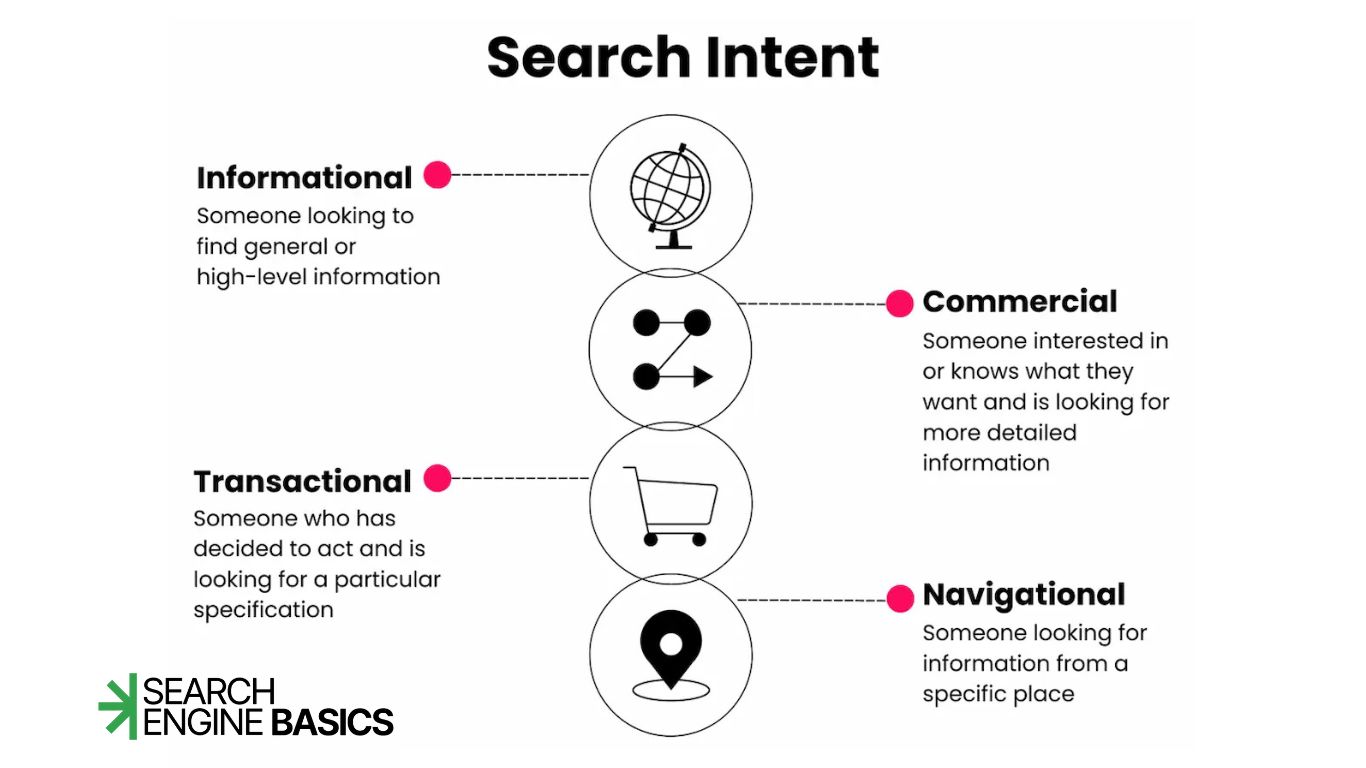
Google and most SEO researchers group queries into four buckets. Each one points at a different stage of what the searcher wants to do.
1. Informational Intent
The searcher wants to learn something. No purchase, no specific website in mind, just an answer.
Example: “how does indexing work”
Someone typing that wants a clear explanation, not a product page. If a results page returned a software ad here, it would feel off, and bounce rates would say so.
2. Navigational Intent
The searcher already knows where they want to go. They’re using the search bar as a shortcut instead of typing a full web address.
Example: “facebook login”
Google’s job here is simple compared to the other types: surface the official site fast. Ranking for navigational queries tied to your own brand name is usually easy. Ranking for someone else’s brand name is nearly impossible, and frankly not worth chasing.
3. Commercial Intent
The searcher is comparing options before they buy. They haven’t decided yet, but they’re close.
Example: “best seo tools”
Pages that win here tend to be comparisons, reviews, or roundups. The reader wants pros, cons, and a recommendation, not a sales pitch from one company about itself.
4. Transactional Intent
The searcher is ready to act now. Buy, sign up, download, book.
Example: “buy seo course”
This is the bottom of the decision. The reader already knows roughly what they want. They need a direct path to get it, not a long explainer.
Why Search Engines Try to Match Intent
Picture a “buy” query returning a dictionary definition instead of a place to actually purchase something. The searcher would leave immediately, try a different query, or give up on the search engine altogether. Google calls that a failed result, and failed results get demoted over time as user behavior signals feed back into ranking.
This is part of what Google’s Search Central documentation refers to when it discusses relevance: a page can be accurate, well written, and still rank poorly if it answers a question nobody asked. Google’s documentation explains that pages need to provide content that is “satisfying for users” and meets their expectations for a given query. Intent mismatch is one of the most common reasons that satisfaction breaks down, even when the content itself is correct.
A common beginner mix-up: assuming relevance is only about topic overlap. A page about “SEO tools” stuffed with the right keywords can still fail if it’s written as a sales page when the query signals the reader wanted a comparison. Topic and intent are two separate filters, and a page has to clear both.
How Intent Signals Show Up in Search Results
You can often guess intent just by looking at what’s already ranking for a query, since Google has already done the matching work for you.
| Intent Type | Common SERP Features | What Usually Ranks |
| Informational | Featured snippets, People Also Ask, AI Overviews | Guides, explainers, definitions |
| Navigational | Sitelinks, knowledge panel | Official brand homepage |
| Commercial | Comparison tables, review snippets | Roundups, “best of” lists |
| Transactional | Shopping results, ads | Product or pricing pages |
If you search a target keyword and see mostly “best X” listicles, that’s a strong clue the intent is commercial, not informational. Writing a plain definition page for that keyword would be fighting the wrong battle.
One thing worth being upfront about: intent classification isn’t always clean. Some queries sit between two categories, and AI Overviews in 2026 sometimes blend an informational answer with commercial suggestions in the same response. Treat these four types as a useful starting framework, not a rigid rulebook that covers every query perfectly.
Connecting Intent Back to Keyword Research
Keyword research without intent is just a list of words. Once you sort those words by intent, the list becomes a content plan. A keyword with informational intent points you toward a guide or FAQ page. One with transactional intent points you toward a landing page built to convert, not educate.
This is why pulling search volume alone isn’t enough when picking what to write. A high volume keyword with the wrong intent for your page type will bring traffic that bounces straight back to the results, which helps nobody, including your rankings.
What to Read Next
If you haven’t worked through keyword research basics yet, start with our Keywords pillar page, which covers how to find and group keywords before you ever start writing. For the bigger picture on how search engines decide what to show for any query, our Search Engine Basics pillar page walks through crawling, indexing, and ranking from the ground up.
FAQ’s About What Is Search Intent
1. Can one query have more than one type of intent?
Yes. Some queries are mixed, especially when a searcher is researching and comparing at the same time. AI Overviews in 2026 sometimes reflect this by blending a direct answer with linked product suggestions.
2. Does Google publish an official list of intent categories?
Google hasn’t published a single official taxonomy. The four type framework comes from longstanding SEO industry research and is widely used because it maps cleanly onto observed searcher behavior.
3. How do I figure out the intent behind a keyword I’m targeting?
Search the keyword yourself and look at what’s already ranking. The format of the top results, whether that’s guides, product pages, or comparison lists, tells you what Google has already decided the intent is.